- Your cart is empty
- Continue Shopping

Fenbendazole for Humans: What You Actually Need to Know Before Trying It

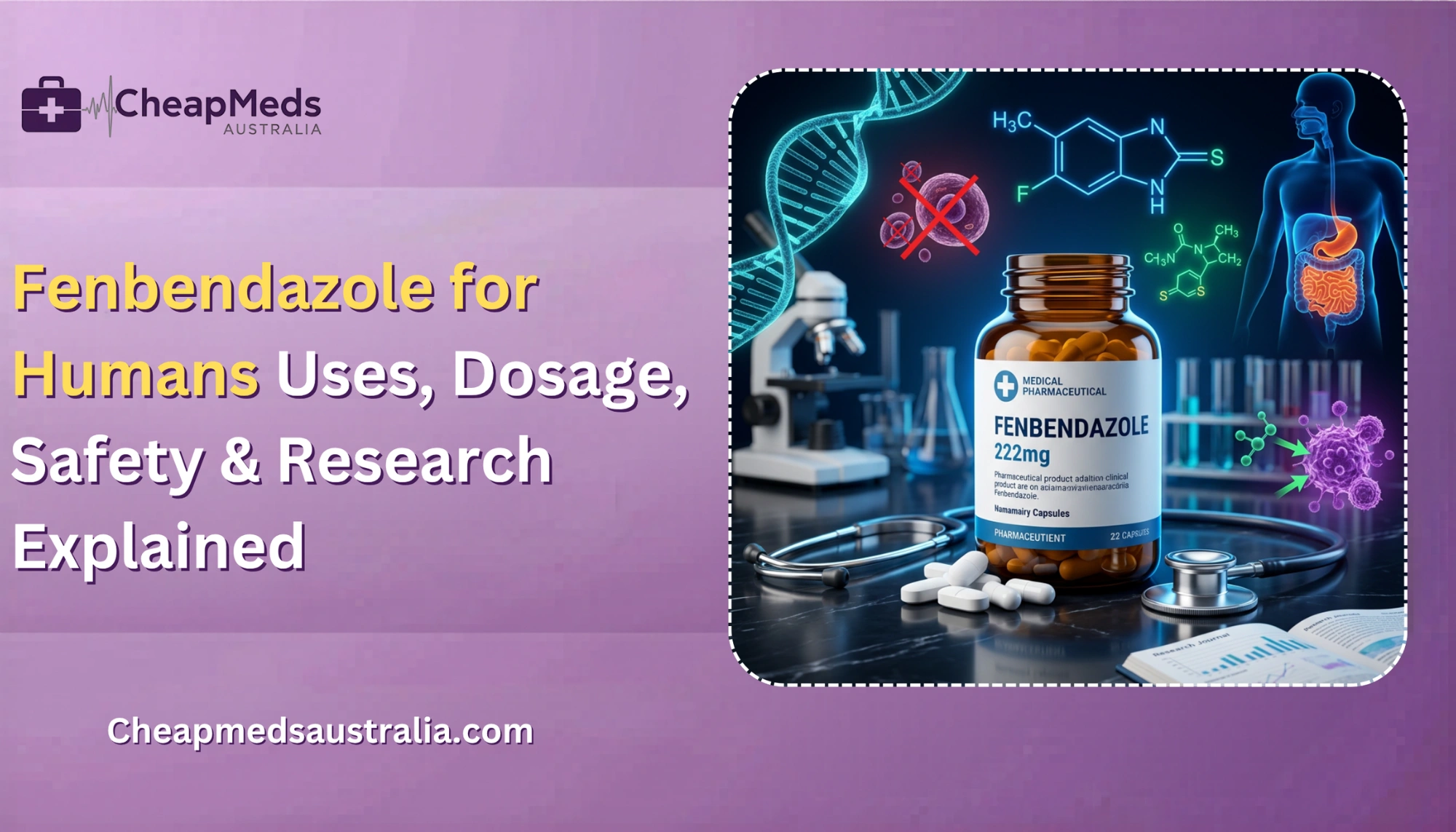
There is a discourse happening in the health circles that mainstream medicine has not quite caught up with yet. Fenbendazole is the medicine that vets reach for when treating worms in dogs, cats, and other animals, and somehow it has landed at the core of human health issues. And, truthfully? The curiosity is understandable.
But before you order anything or take any dose, it’s worth understanding what this drug truly does, where the evidence rests right now, and what responsible use looks like for humans. Let’s get stuck into it properly.
What Is Fenbendazole and Why Are Humans Talking About It?
Fenbendazole is a member of the benzimidazole class of drugs, which are broad-spectrum antiparasitic chemicals used for decades in veterinary medicine. It’s the active ingredient in products like Panacur and Safe-Guard. The mechanism is quite straightforward: it stops the synthesis of microtubules in infected cells, thereby starving and killing the parasite.
So why has it crossed over into human territory?
A lot of it may be traced back to a viral article from around 2019. Joe Tippens is an American man who was diagnosed with stage 4 small-cell lung cancer. He said his cancer totally disappeared when he took fenbendazole plus a few additional vitamins. The news spread quickly, especially in South Korea, where it caused a national shortage of the medicine. Researchers began to pay attention, and a few preclinical investigations ensued.
That’s where the conversation truly began today. Not from a clinical experiment. From the tale of one man. And that background is important. We’ll be back to it.
Human Uses of Fenbendazole — What People Are Actually Taking It For
If you’ve found yourself here, you’ve probably heard something about fenbendazole and are trying to see if it’s worth your time. Fair enough. Let’s break down what people are actually utilizing it for—because the reasons vary quite a bit depending on who you ask.
For Parasitic Infections
This is the most straightforward one. Fenbendazole acts almost exactly like mebendazole and albendazole – medications that doctors already administer to humans to treat worm infections. The distinction is that fenbendazole was never formally approved for use in humans. Those who have tried the permitted choices without much luck have discreetly switched to fenbendazole and reported great outcomes. It’s the same drug family, just with a new label.
For Cancer — This Is the Big One
Let’s be honest, this is why most people are looking for it. People diagnosed with dangerous cancers, particularly those who believe that traditional medicine has run out of road, have been adding fenbendazole to their daily regimen ever since the Joe Tippens story began circulating. Not instead of treatment. But together with it. The lab work behind this is still in its infancy, but it’s real enough that people are not waiting for clinical trials.
General Gut Health and Parasite Prevention
A quieter group takes fenbendazole every few months as a broad-spectrum cleansing. This group generally includes frequent travellers, those who have had recurrent stomach problems or people who just like to have a reset now and then.
Note: Fenbendazole is a veterinary product in Australia, and most individuals get it from online sources, which is uncomplicated to do.
The Joe Tippens Protocol — The Story That Started Everything
In 2016, Joe Tippens was given three months to live. Small cell lung cancer in his whole body, stage 4. By 2017, it was claimed that all the tumours were gone.
What has changed? A vet buddy had observed surprising outcomes in animals, so on his recommendation, he began taking fenbendazole, especially 222mg of Panacur C granules, along with three supplements. The protocol he used is called simply the Joe Tippens Protocol, and it looks like this:
| What | Dose | When |
| Fenbendazole (Panacur C) | 222mg | 3 days on, 4 days off |
| Vitamin E Succinate | 400–800mg | Daily |
| Curcumin (Bioavailable) | 600mg | Daily |
| CBD Oil | 25mg | Daily |
The assumption behind combining these four is that they each attack cancer in a slightly different biological way: fenbendazole stops the cancer cells from dividing, vitamin E succinate promotes cancer cell death, curcumin fights inflammation, and CBD helps with overall health and sleep quality.
Here’s the honest caveat, though: Tippens was also enrolled in an experimental immunotherapy trial at the same time. Whether fenbendazole was responsible, the immunotherapy, a combination of both, or spontaneous remission — no one can say with certainty. That detail often gets quietly left out when the story circulates online. It’s a compelling story. It’s just not controlled evidence.
If you’re researching antiparasitic medicines for humans, you can check out our available Fenbendazole 222mg tablets for additional product information and usage guidance.
Fenbendazole Benefits for Humans — What the Research Shows
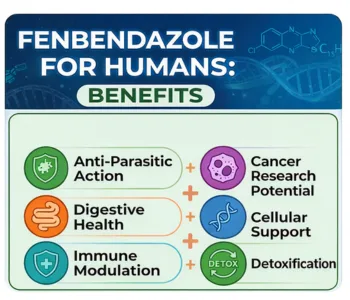
The hype over fenbendazole isn’t just anecdotal. There’s a growing body of early research that experts are really interested in — even if it hasn’t yet turned into approved human medicines.
Fenbendazole’s particular effect on cancer cells has been the focus of several lab studies. Scientific Reports published a study in 2018 that showed anti-tumour efficacy against non-small-cell lung cancer cell lines. Other in-vitro studies have looked at impacts on colorectal, prostate and glioma cells.
Researchers are examining techniques such as blocking the entry of glucose into cancer cells, thereby starving tumours of their fuel, interfering with cell division and some possible interaction with p53, a crucial protein used by the body to control tumour growth.
Beyond cancer, the antiparasitic benefits in animals are well known and logically extend to people, given the shared pharmacological mechanism with already-approved human medications.
Fenbendazole Dosage for Humans — The Protocols People Follow
There are no formal human dose standards, just anecdotal protocols passed about in online communities. The most common is the Tippens protocol above, which is 222mg for three days straight, then four days off, then repeat the cycle.
Some people take it daily at lower doses. Others do a dose once a week. The most prevalent method is a cycling strategy, partly owing to worries about constant liver stress.
A few practical notes:
- Always take with meals – absorption is much increased with a fatty meal
- If you miss a dosage, do not take double doses; maintain consistency in dosing
- Liver function test – baseline before starting, and repeat 4–6 weeks after
These are not medically approved schedules. They are from the community. Anyone thinking about it should be doing so with it clearly in mind – and ideally with a GP ready to keep an eye on basic blood tests too.
Looking for a higher-strength antiparasitic option? Explore our Fenbendazole 444 mg tablets for detailed product information and usage guidance.
Fenbendazole Side Effects and Safety — What to Actually Watch For
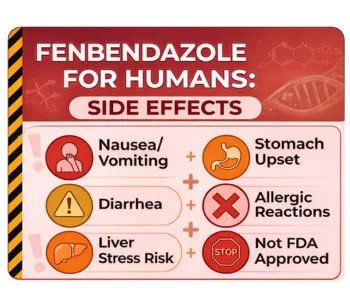
Here’s one factor that drives the appeal of fenbendazole over other experimental options: the short-term side effect profile appears to be rather modest, according to the current data.
Most frequently recorded from human use:
- Mild digestive disturbance, such as nausea, bloating, loose stools, especially in the first few days
- Elevated liver enzymes (transaminases) – this one really demands attention
- Fatigue in some circumstances, particularly at higher doses
The liver point is worth paying attention to. There are a few case reports of drug-induced liver impairment in persons who used fenbendazole continuously for prolonged periods on a self-administered basis. A short course at conventional doses provides a distinct risk profile from months of daily use — yet monitoring is important either way.
Be extra careful or avoid entirely if:
- You’re pregnant or breastfeeding
- You already have a liver condition
- You’re on medications that are metabolized by the CYP450 enzyme system, including a lot of common pharmaceuticals
- You are on chemotherapy – interactions are not well understood yet
Frequently Asked Questions About Fenbendazole for Humans
1. Is fenbendazole legal to buy in Australia?
Fenbendazole can be bought legally in Australia. It’s a veterinary product. Not a restricted substance.” Most Aussies buy it from online providers without any trouble. Just be aware that you are buying it as a veterinary product – the TGA hasn’t certified it for human use, so it’s not available through a GP or pharmacy.
2. Can fenbendazole treat cancer in humans?
There is no clinical evidence of this yet. You have some really intriguing preclinical work, and a lot of appealing anecdotal instances – including Tippens. But there’s a huge difference between anecdotal evidence and test results and established clinical consequences. The reality is that we don’t know yet. Anyone who says they do is ahead of the science.
3. How long before fenbendazole starts working?
For antiparasitic usage, usually for a few days. Anecdotal reports for people following the cancer protocol range anywhere from weeks to months — but there is considerable individual diversity, and no solid baseline.
4. Can you take fenbendazole every day?
Some people do, but safety for daily long-term use has not been studied in humans. Most protocols use the 3-days-on, 4-days-off cycle strategy for a reason — it minimises continuous burden on the liver and conforms to the schedule Tippens himself adopted.
5. Does fenbendazole interact with chemotherapy drugs?
This is truly uncharted waters. Some researchers have associated specific chemo drugs with theoretical problems. If you’re actively being treated for cancer, this discussion really needs to happen with your oncologist—not about them.
6. What’s the difference between fenbendazole and mebendazole?
They are close cousins, both benzimidazoles, and both act in the same basic way. In many countries, mebendazole is the approved form for human antiparasitic usage. Fenbendazole is the veterinary member of the family. They are chemically close but not identical, and are not interchangeable from a regulatory approval perspective.
7. Should I take fenbendazole with food?
Yes, and preferably with something that has got fat in it. Fenbendazole is fat-soluble, so absorption is much better if taken with a meal. Most people eat it with breakfast or their major meal of the day.
If you’re exploring fenbendazole for dogs, our Panacur 150 mg dog deworming tablets provide more information about parasite treatment and intestinal worm control.
Note: This article is for informational purposes only and does not constitute medical advice. Always consult a qualified healthcare professional before starting any new supplement, medication, or off-label treatment. Individual health circumstances vary — what works for one person may not be appropriate for another.