- Your cart is empty
- Continue Shopping

How Ivermectin Works to Fight Parasite Infections in Humans

If you’ve ever been prescribed ivermectin by a doctor and gone home wondering, what precisely is this pill doing inside my body, you are not alone. Most people take it, the infection clears, and life goes on — but there’s actually a fairly intriguing process going on under the hood that not many people completely understand.
This post explains it in simple terms. No Jargon Overload, No Lecture. A real walkthrough of how ivermectin works, what it treats and what you really need to know before taking it.
What Is Ivermectin and Why Do Doctors Prescribe It?
Ivermectin is an antiparasitic medicine that has been in use since the late 1970s. Initially, it was made for veterinary purposes – mainly to protect animals and pets from internal and external parasites. It was licensed for human usage in the 1980s, and since then, it’s become one of the most extensively used antiparasitic medications on the planet.
Indeed, the World Health Organisation lists ivermectin as an important medicine. That’s not something that happens easily. It’s used to treat various parasite illnesses – from intestinal worms that burrow deep into gut tissue, to skin-dwelling mites that cause continuous itching.
In Australia, ivermectin is used to treat scabies, strongyloidiasis and other helminth infections. It is prescription only, and doctors typically turn to it when they know the infection is present, and other therapies have failed, or when it’s simply the best first treatment.
How Ivermectin Actually Works Inside the Human Body
Here is when it gets really interesting.
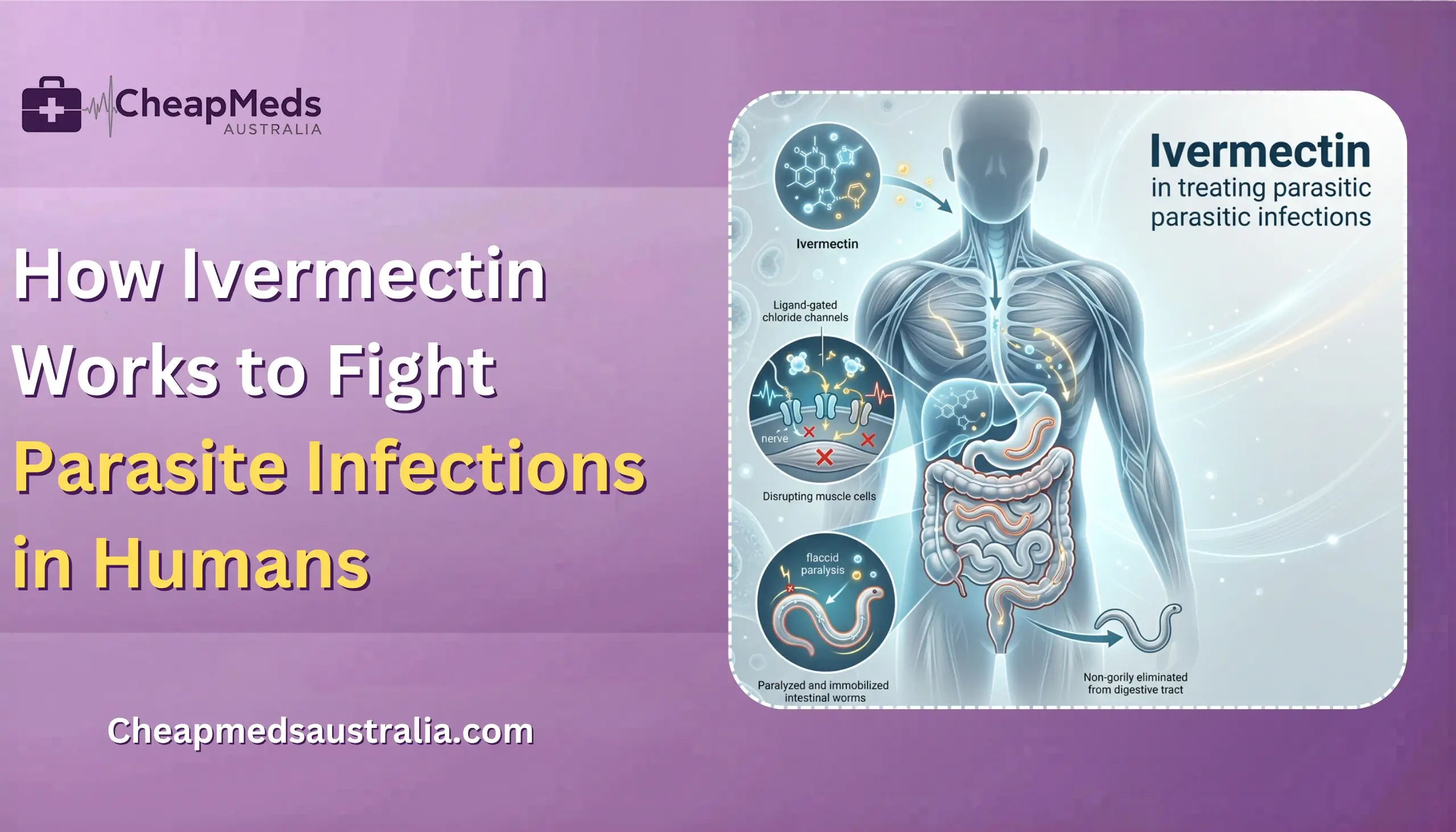
When taken by mouth, ivermectin tablets are absorbed from the gastrointestinal system into the bloodstream. From there, it travels to wherever parasites happen to be dwelling in your body – be it in your stomach, skin or lymphatic tissue.
The key target: glutamate-gated chloride channels
Ivermectin attaches itself to a specific type of ion channel in the nerve and muscle cells of parasites. The channels are called glutamate-gated chloride channels, and they control how the parasite’s brain system and muscles work.
When ivermectin binds to these channels, they open up. That allows a surge of chloride ions into the parasite’s nerve or muscle cells. The bottom line? The parasite is entirely paralysed. It can’t move, can’t eat, can’t reproduce. And eventually it dies – or is removed by your immune system while it’s immobilised.
Dealing with mixed parasite symptoms like weakness, itching, or digestive discomfort? Ivermectin and albendazole work together to help clear infections from the body.
Why doesn’t Ivermectin harm human cells the same way?
That’s a good question. In short, humans don’t have the same kind of glutamate-gated chloride channels that the parasites have. Our cells handle chloride differently. This is why, at normal therapeutic levels, ivermectin is lethal to parasites but has no effect on human nerve cells.
There is also a structural barrier called the blood-brain barrier that under normal circumstances prevents ivermectin from entering the human central nervous system in significant amounts under normal circumstances. That’s a significant part of why it’s safe when used correctly.
Parasite Infections That Ivermectin Is Used to Treat
Ivermectin isn’t a one-size-fits-all antibiotic. It is an antiparasitic, particularly. Works better on some forms of parasites than others.
Strongyloidiasis
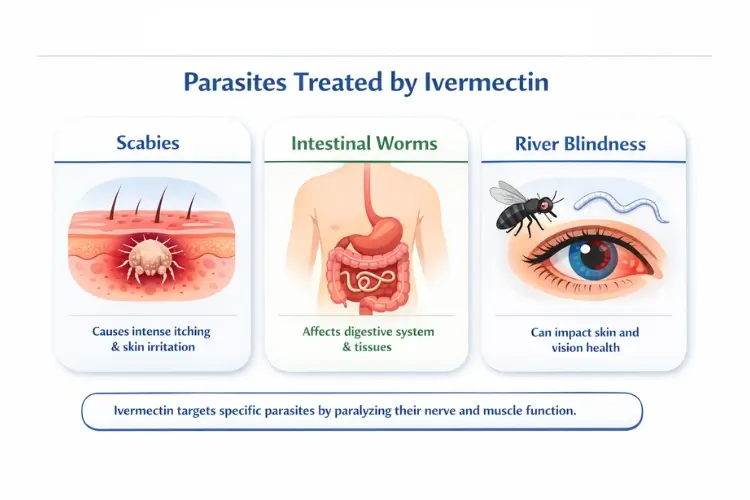
This is one of the most common applications in Australia. Strongyloides stercoralis is a roundworm that can enter the body through bare skin — usually from polluted soil. It burrows into tissue, finds its way to the intestines and can live and multiply in the body for years without evident signs. Ivermectin works well to clear it, usually in 1 or 2 doses.
Scabies
Scabies is caused by a tiny mite called Sarcoptes scabiei. The mite burrows into the skin, lays eggs and produces acute itching, especially at night. It is used for ordinary scabies but is especially useful for crusted (Norwegian) scabies, where the mite burden is substantially higher and topical therapies alone are not adequate.
Dealing with scabies-related itching or discomfort? Ivermectin topical treatment works where the infection starts, helping your skin heal faster.
Onchocerciasis (River Blindness)
This is a parasitic infection caused by a worm spread through bites from blackflies. It’s more frequent in sub-Saharan Africa than it is in Australia, but this is a situation where ivermectin has really impacted the outcome globally. Mass distribution programmes of ivermectin have drastically reduced the occurrence of blindness from this illness.
Other worm infections
Ivermectin is also used for several other helminths (parasitic worms), such as Wuchereria bancrofti (lymphatic filariasis) and Mansonella infections.
Ivermectin Dosage: What You Should Know
The Ivermectin dose is typically based on body weight. The usual adult dose for most infections is 150-200 micrograms per kg of body weight, administered orally as a single dose with water (preferably on an empty stomach or at least two hours before a meal).
For conditions like strongyloidiasis, occasionally a second dosage is given a couple of weeks later to catch any larvae that survived the initial round. Repeat dosing may be needed for scabies, especially in community infestations.
Do not self-adjust the dose. Some medications are not superior in higher doses. The proper amount for you will depend on your weight, the infection you have and your general health. Always follow the directions of your prescribing doctor.
Also Read: Complete Guide to Fenbendazole Use in Human Parasite Care
Side Effects Worth Knowing About
Ivermectin is generally well-tolerated by most people. Serious adverse reactions are rare at recommended levels for recognised indications.
The ones that are reported more commonly include:
- Mild dizziness or lightheadedness
- Stomach upset or nausea
- Headache
- Skin rash or itching (this sometimes is actually a reaction to dying parasites, not to the medicine itself)
- Temporary swelling, especially in the treatment of a filaria-related infection
There is a process called the Mazzotti reaction or Jarisch-Herxheimer-like reaction that can occur with large worm loads. This occurs when a significant number of parasites die rapidly, producing chemicals that stimulate an immunological response. It can be flu-like and produce fever, joint discomfort and skin problems. Usually, it sorts itself out in a day or two.
If you experience confusion, difficulty walking, chest pain or significant swelling, get medical help immediately.
Feeling weak and uneasy due to a parasite infection? Ivermectin 6 mg supports effective parasite removal.
A Few Things People Often Get Wrong About Ivermectin
It’s not an antibiotic. Ivermectin does nothing for viruses, bacteria or fungi. It is for the parasites, specifically.
It doesn’t prevent re-infection. Once the infection is cleared, there is no ongoing protection from a round of ivermectin. “If you are re-exposed to contaminated environments, you can be re-infected.
Veterinary formulations are not interchangeable with human-grade medication. The ingredients and concentrations are very different. Animal ivermectin products are not safe for humans to use.
FAQs About How Ivermectin Works
1. How long does ivermectin take to work?
Ivermectin works rather rapidly after it is absorbed. If you have an illness with intestinal worms, you may start to feel better in a few days. With scabies, the itching may continue for a few weeks after the mites are dead. It is a skin reaction, not an indication that the therapy has failed.
2. Can ivermectin be taken with food?
Ivermectin is normally recommended to be taken on an empty stomach or 2 hours after a light meal. Some studies have suggested that eating it with a high-fat meal can considerably improve absorption, and this may impact the dose. Follow your doctor’s directions exactly.
3. Is ivermectin safe for everyone?
Ivermectin is not indicated for children weighing less than 15 kg and should be used with caution in pregnancy. Those with particular liver diseases or who take certain drugs may also need to be dosed or monitored differently. Always tell your doctor your full medical history.
4. What happens if I miss a dose?
If you miss a dosage of most ivermectin medications, you merely need to reschedule. If you’re on a multi-dose regimen, take the missing dose as soon as you remember (unless it’s almost time for the following dose). Don’t double dip.
5. Can ivermectin be bought over the counter in Australia?
In Australia, ivermectin is a prescription-only medicine (Schedule 4). You can’t get it legally without a legitimate prescription from a qualified doctor. Australian regulated online pharmacies will demand a valid prescription before they may dispense.
6. Does ivermectin interact with other medications?
Ivermectin can interact with some medications, including warfarin, a blood thinner. It may potentially interact with drugs that influence liver enzymes. Always tell your doctor what medications and supplements you are taking before starting ivermectin.
Final Thoughts
Ivermectin is one of those drugs that gets a little more respect than it typically does, not in a hype-it-up sort of manner, but in a quiet, it-works-really-well-for-what-it’s-designed-for sort of way. Its mechanism is precise, its safety profile at regular doses is well established, and for the correct diseases, it can clear up situations that could otherwise hang on for months or years.
If you’ve been prescribed ivermectin or you’re considering treatment options for a parasite infection, the most crucial step is always to have a chat with a skilled healthcare provider who understands your individual case. Once you obtain that prescription, online pharmacies like Cheap Meds Australia can make access easier. But the diagnosis and dosage decision should always come from a doctor first.